Louisville's Peer Metros in Housing Stability: Black Population Percentage

The final metric that we put to use in the quest to find Louisville’s peer metros in housing stability is Black population percentage. Similar to the MSA population metric, this one is a more indirect measure, but it is vital for helping us understand how place-based barriers and opportunities interweave with complex social currents such as concerted anti-Black racism, pro-Black solidarity and resilience, and interracial cooperation and community building. In comparison to the past two metrics we covered for Louisville and its peer metros, there is a noticeably greater range in the Black percentage values (see graph below). For example, while there is just a 1.8-percentage-point range in the poverty rate numbers, the range for the Black population figures is 4.9 percentage points.
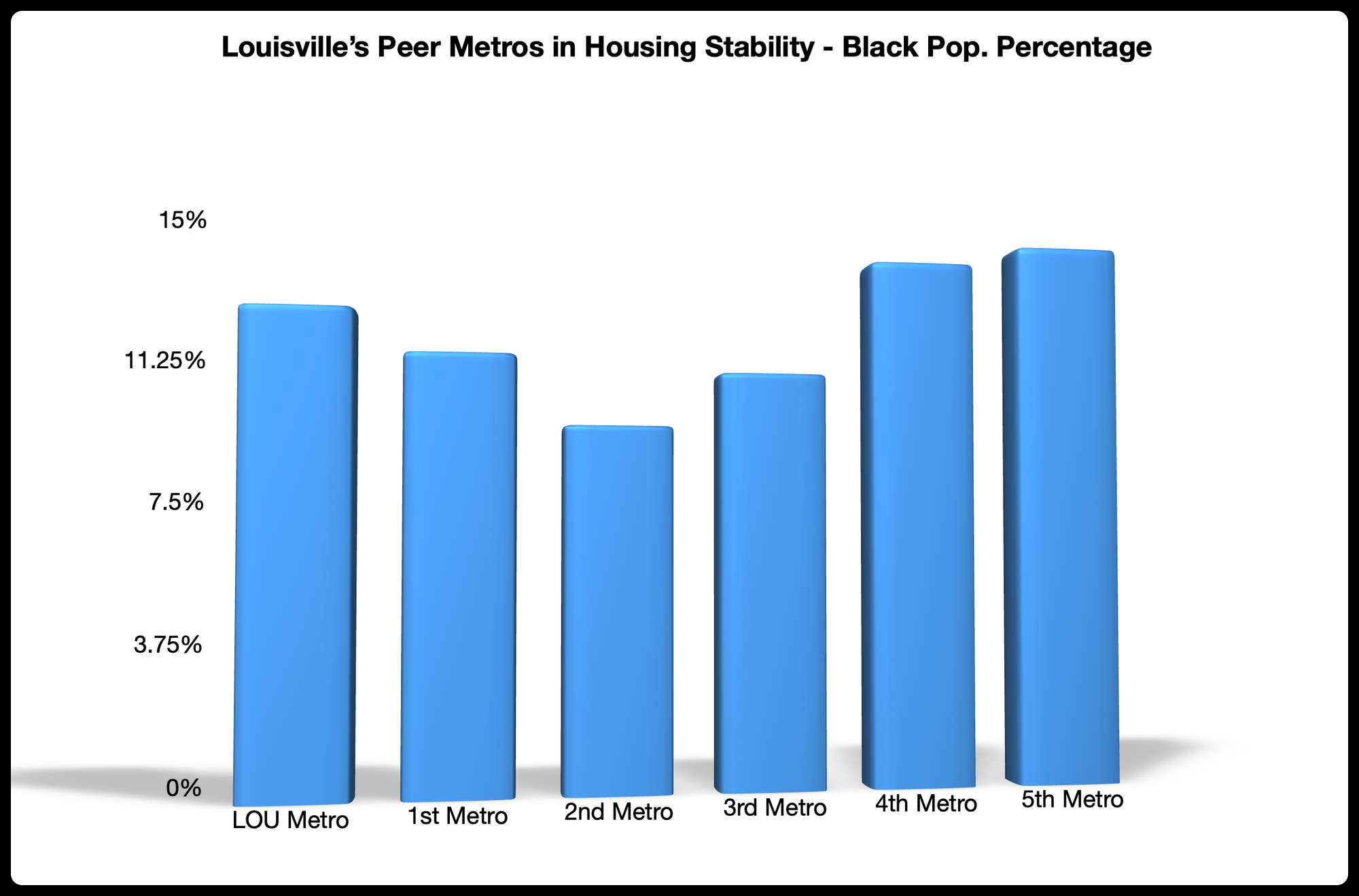
The metro with the poverty rate closest to the Louisville value is the metro that is its closest peer overall. This means that on three out of five measures, this particular metro turned out to be the closest peer. Considering the overall number of mid-sized metropolitan areas and how tightly these five peers relate to Louisville across the measures, this is quite remarkable. That said, the metro that is second-closest to Louisville overall has the Black population percentage that is most distant from the Louisville value. This same metro also had one of the most distant poverty rates. The fact that it remains second-closest overall speaks to the strength of its proximity on the MSA population and median home value fronts.
We look forward to sharing more details next week and putting a name to Louisville’s peer metros in housing stability. We’ll also discuss the underlying logic of the analysis and begin the benchmarking process. Be sure to subscribe if you would like to learn more.